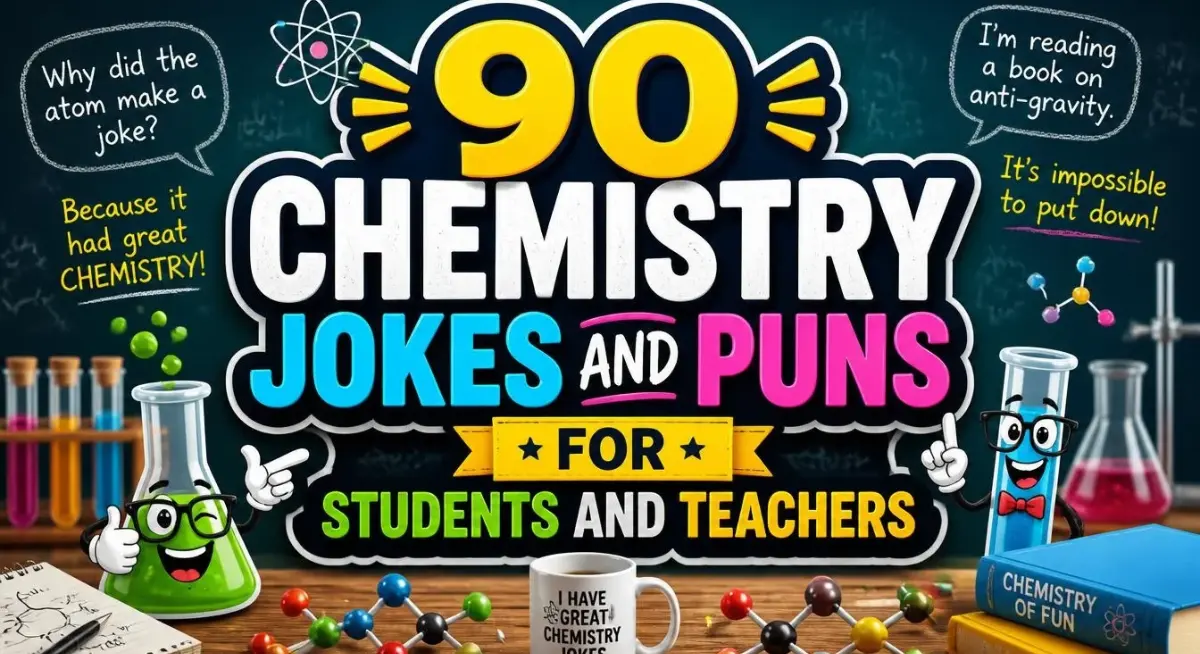
Chemistry jokes work because the subject is full of wordplay waiting to happen. Elements have odd names and two-letter symbols that sound like everyday words. Reactions have dramatic outcomes. Terms like bond, solution, stable and charge already mean something outside the lab, so a pun is only a half step away.
This collection covers atoms, elements, the periodic table, lab equipment and reactions, plus knock-knock jokes, jokes for kids and one-liners for captions. Every joke is clean and family friendly, and each one is built for a groan. Share them with students, teachers or anyone who survived high school chemistry. Near the end you’ll find a short guide to the science behind the puns, a method for writing your own, tips on using them, and a set of FAQs.
What Makes a Chemistry Joke Work
A good chemistry joke needs two things: a science term and an everyday meaning for the same word. Positive is a charge and a mood. Bond is a link between atoms and a link between people. Solution is a mixture and an answer. When one word does both jobs, the joke almost writes itself.
The best ones also keep the science correct. A joke about a neutron having no charge works because neutrons really have no charge, and a joke about a catalyst speeding things along works because that is exactly what a catalyst does. The facts give the pun something to stand on.
Classic Chemistry Jokes
These are the ones that show up in every classroom. They are simple, easy to remember and hard not to repeat.
- Why did the chemist and the biologist break up? There was no chemistry.
- Why are chemists so good at solving problems? They have all the solutions.
- What is the chemical formula for water? H2O. What about ice? H2O cubed.
- What did the scientist say when he found two isotopes of helium? HeHe.
- What do you call an iron ride at the fair? A ferrous wheel.
- Why is sodium so confident? It’s Na-turally awesome.
- Never trust atoms. They make up everything.
- A neutron walks into a diner and asks how much for a drink. The owner says, for you, no charge.
- What do you call a tooth in a glass of water? A one molar solution.
- Why did the electron cross the road? It was attracted to the other side.
Periodic Table Jokes
The periodic table is a gift for puns. Every element name and symbol is a setup waiting for a punchline.
- What did the chemist say when she found gold? Au, there you are.
- Why did oxygen and magnesium go on a date? OMg, it went great.
- If you’re not part of the solution, you’re part of the precipitate.
- Why did helium leave the party early? It was feeling light-headed.
- Neon is a real glow-getter.
- Why does hydrogen always get the first pick? It’s number one on the table.
- Carbon is great at relationships. It forms four bonds.
- Why was iron so good at the gym? It always pumped iron.
- Why did the noble gas stay home? It’s inert and happy that way.
- What’s a metal’s favorite kind of music? Heavy metal.
Atom Jokes
Atoms are the building blocks of matter and of chemistry jokes. These cover protons, neutrons, electrons and the space between them.
- Two atoms are walking down the street. One says, I think I lost an electron. The other says, are you sure? The first says, yes, I’m positive.
- Why did the atom feel lonely? It had no bonds.
- Why did the atom break up with the molecule? It needed space.
- What do you call an atom that can’t decide? An unstable isotope.
- Why are protons so honest? They’re always positive.
- Why did the neutron stay so calm? It had no charge to worry about.
- What did one electron say to the other? Stop being so negative.
- Why did the electron feel so energetic? It jumped up an energy level.
- What do you call an atom that loves a party? A mole of fun.
- Why was the atom a good listener? It always kept its nucleus open.
Element Jokes
Every element has a personality if you look hard enough. These jokes give them one.
- Why did hydrogen and oxygen make such a great team? Together, they made water.
- Why did sodium and chlorine get along so well? They made a perfect pair, and the result was salt.
- Aluminum never gets tired. It’s a lightweight champion.
- What do you call a lithium joke? A light-hearted one.
- Carbon is under a lot of pressure, but it turns into diamonds.
- Why is neon so popular? It always shines in a crowd.
- Why did calcium get invited everywhere? It has a lot of backbone.
- Why did copper feel rich? It was worth every penny.
- Why was mercury always on the move? It couldn’t stay in one place.
- Why did silicon get a job in tech? It was a chip off the old block.
Lab Equipment Jokes
Every lab has its own comedy. These jokes cover the tools of the trade, and a reminder: real labs need real safety rules.
- Why did the beaker break up with the test tube? It felt like it was always being handled.
- Why did the scientist bring a ladder to the lab? To reach the top shelf of chemicals.
- Why did the scientist bring a pencil to the lab? To draw conclusions.
- Why was the Bunsen burner so popular? It was always the hot topic.
- Why did the test tube get detention? It was mixing with the wrong crowd.
- Why did the microscope get a promotion? It had a great eye for detail.
- Why was the flask so calm? It knew how to hold things together.
- Safety goggles always keep an eye out for you.
- Why did the lab coat win an award? It covered every situation.
- Why did the scale feel balanced? It knew exactly how much was too much.
Reaction Jokes
Reactions are the heart of chemistry, and the heart of these jokes.
- What do you call a reaction that never stops? A chain reaction.
- Why was the reaction so slow? It was waiting for a catalyst.
- Why was the acid in a bad mood? It had a low pH, and that put it in a sour mood.
- What did the buffer say to the acid? Stay calm, I’ve got you.
- Why did the solution get a promotion? It was always the answer.
- Why was the mixture so confused? It couldn’t separate its feelings.
- Why did the reaction need a break? It was running out of energy.
- What did the beaker say to the reaction? Let’s mix it up.
- Why was the reaction so dramatic? It always gave off a lot of heat.
- What did the catalyst say? I’m just here to speed things along.
Chemistry Knock-Knock Jokes
Short, simple and perfect for the classroom. These are easy to remember and easy to repeat.
- Knock knock. Who’s there? Ion. Ion who? Ion know, I forgot the joke.
- Knock knock. Who’s there? Cobalt. Cobalt who? Cobalt you earlier, but you didn’t answer.
- Knock knock. Who’s there? Tin. Tin who? Tin-k about it, I’m freezing out here.
- Knock knock. Who’s there? Lead. Lead who? Lead me in, it’s cold.
- Knock knock. Who’s there? Radon. Radon who? Radon the street to get here, let me in.
- Knock knock. Who’s there? Argon. Argon who? Argon be late if you don’t open up.
- Knock knock. Who’s there? Carbon. Carbon who? Carbon copy, I knocked twice.
- Knock knock. Who’s there? Beaker. Beaker who? Beaker-ful, the lab floor is slippery.
- Knock knock. Who’s there? Calcium. Calcium who? Calcium later, I’ve got class.
- Knock knock. Who’s there? Sulfur. Sulfur who? Sulfur real, I’ve been out here for ages.
Chemistry Jokes for Kids
These are clean, simple and perfect for young science fans. Most of them come from experiments kids already know.
- Why did the chemist become a chef? He wanted to experiment with food.
- Why was the baking soda so excited? It was about to have a big reaction with the vinegar.
- What did the volcano experiment say? I’m about to erupt with joy.
- Why did the little scientist wear goggles? Safety first, and they looked cool.
- Why was the ice cube sad? It was feeling a little melted down.
- Why did the kid bring a magnet to class? He wanted to be attracted to science.
- What did one water molecule say to the other? Let’s stick together.
- Why was the slime so popular? It was always stretching out to its friends.
- Why did the test tube feel proud? It passed the test.
- What did the little scientist say to the periodic table? You’re my favorite chart.
Chemistry One-Liners for Quick Laughs
These are perfect for captions, group chats or anytime you need a quick pun.
- I have all the solutions.
- I’m in my element.
- We have great chemistry.
- You’re the catalyst for my happiness.
- I’m positively charged today.
- Let’s bond over chemistry.
- I’m going through a phase.
- This joke is a little too reactive.
- I’m feeling unstable today, but I’ll stabilize.
- That joke got a reaction.
The Science Behind the Puns
A short list of terms makes the jokes easier to follow, especially for readers who left chemistry class a while ago.
An atom is the smallest unit of an element. An ion is an atom that has gained or lost electrons, which gives it a charge. An isotope is a version of an element with a different number of neutrons. A catalyst is something that speeds up a reaction without being used up. A precipitate is a solid that forms when two solutions react. A mole is a counting unit for a very large number of particles. The pH scale measures how acidic or basic a liquid is. A noble gas, such as helium, neon or argon, is a gas that rarely reacts with anything.
When a joke feels confusing, check which of those terms it uses. Nearly every one in this list leans on one of them.
Coming Up With Your Own Chemistry Jokes
Writing a chemistry joke takes a few minutes once you know the pattern. Start with a science word that also has an everyday meaning.
Try pairs like positive (a charge and a mood), bond (a link and a relationship), solution (a mixture and an answer), stable (a state and a personality) and reactive (a chemical trait and a quick temper). Pick one pair, then write a short sentence that works with both meanings. Element symbols are another source: Na sounds like nah, Au sounds like oh, and OMg spells out a familiar exclamation.
Read your joke out loud, and cut any word that doesn’t help the twist. If you need more than a few seconds to explain it, shorten it or switch to a different word.
Element Symbols That Sound Like Words
Element symbols are a quiet source of puns, because many of them sound like short words. Cu sounds like see you, which turns a goodbye into “Cu later.” Na sounds like nah, so a flat refusal becomes “Na, I’m not telling you.” Au sounds like oh, which is why gold shows up in lines like “Au, there you are.” He sounds like he or hee, O sounds like oh, I sounds like eye, B sounds like bee, C sounds like sea, S sounds like ess and Y sounds like why.
Two symbols side by side can spell out a whole reaction. O next to Mg reads as OMg, an exclamation most people recognize right away. Once you start looking at the periodic table as a set of small sounds, you’ll see jokes sitting in almost every row.
A Simple Classroom Routine
If you teach chemistry, a short routine keeps the jokes useful instead of distracting. Pick one joke at the start of class and write it on the board without the punchline. Ask students to guess the ending, then reveal it and name the science term behind the pun. The whole thing takes about two minutes, and it gets everyone talking before the lesson starts.
You can also turn it around. At the end of a unit, ask each student to write one chemistry joke that uses a term from the lesson. Reading them aloud is a quick way to check who understood the vocabulary, and the best ones can go on a classroom wall.
How to Use These Chemistry Jokes
These jokes work in more places than you’d expect.
Classrooms: use them as brain breaks. They are short, clean and get students back on task.
Study groups: drop a chemistry pun when the mood gets heavy. It resets the room.
Social media: pair a short pun with a photo of the periodic table. Simple captions do better than long ones.
Birthday cards: write one chemistry joke inside. It works for students and teachers alike.
Science fairs: these jokes make great icebreakers. Everyone knows the basics.
Lab days: use the equipment jokes as a friendly reminder to follow the safety rules.
FAQs About Chemistry Jokes
Why is chemistry such a good subject for puns?
Element names, symbols and terms like bond, solution and charge all have everyday meanings. That overlap gives you a built-in double meaning in nearly every sentence.
Which element symbols give the best puns?
Au, Na and OMg are favorites, since Au sounds like oh, Na sounds like nah, and O plus Mg reads as an exclamation. Cu, which sounds like see you, and He, which sounds like hee, also work well.
Do chemistry jokes help students remember the science?
Teachers often use them as a warm-up, since a funny sentence tends to stick. A joke won’t teach a concept on its own, but it can make a term easier to recall and make a lesson feel lighter.
Are the lab equipment jokes safe for a classroom?
Yes. They poke fun at beakers, goggles and test tubes without encouraging unsafe behavior, and a real lab always needs real safety rules.
What’s the difference between a chemistry pun and a chemistry joke?
A pun relies on wordplay, like Na-turally or a ferrous wheel. A joke can also be a factual twist, like the neutron that charges nothing for a drink. This collection includes both.
How can I make up my own chemistry jokes?
Pick a science term with an everyday meaning, such as positive or bond, then write a short sentence that works both ways. Keep it brief, and read it out loud before you share it.
Conclusion
Chemistry jokes are a tradition in every science classroom. The subject gives you the elements, the reactions and the lab tools, and the puns come from the words that already mean something else. With 90 jokes sorted by topic, you have plenty to choose from.
Pick a few from this list, practice your straight face and deliver them with confidence. The groans are the reward. If your students laugh, even better. If you come up with a chemistry joke of your own, share it in the comments.

Ohad Lesely is a humor writer and content creator who enjoys turning everyday moments into something worth laughing about. At JokesForTeen.com, he focuses on funny jokes, teen humor, clean comedy, relatable moments, and entertaining content designed to bring a little more fun to everyday life.